 INTERCHAIN WORKSPACE
Permissionless interoperability, unpacked.
Understand arbitrary message passing, interchain assets and modular verification, then inspect the adapters behind supported execution.
Hyperlane interoperability
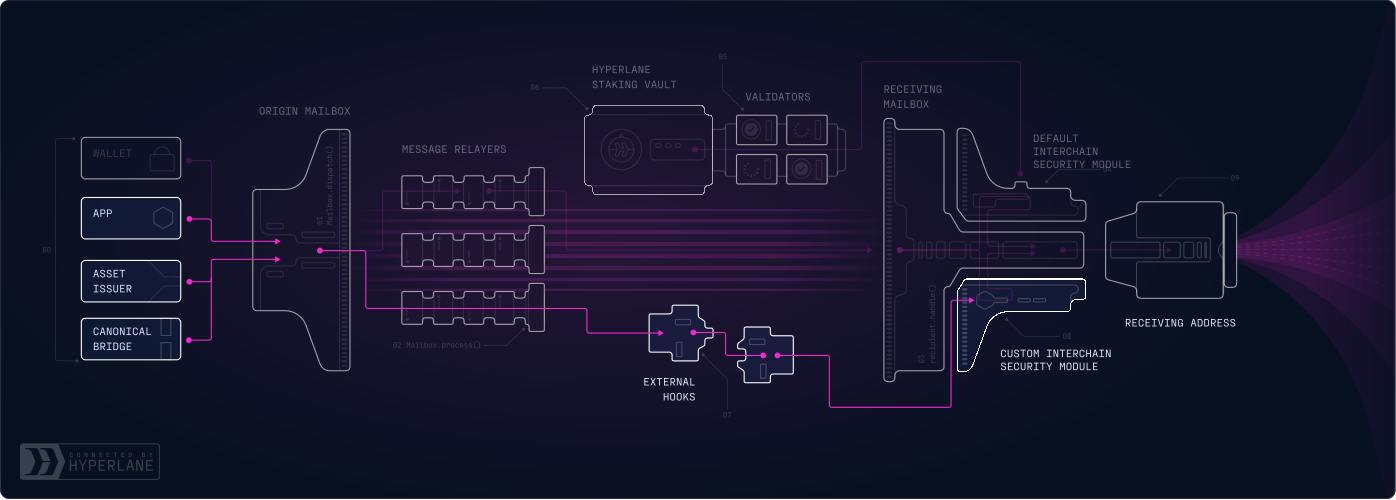
Hyperlane is an open framework for communication between blockchains. Applications send messages through an origin Mailbox; relayers carry those messages and verification metadata to the destination. The receiving application selects an Interchain Security Module to verify delivery.













These logos represent Hyperlane ecosystem references, not a list of executable routes in this application. Availability depends on each deployment and route configuration.
Compose an interchain intentWarp Routes: extend an asset across chains
Warp Routes connect token routers on different networks using Hyperlane messaging. Route configurations determine the token contracts, collateral or synthetic representation, connected domains and verification requirements. Check the precise route before moving assets.
 Inspect supported swap and bridge routes
Application-defined verification
Interchain Security Modules (ISMs) specify the checks required for an incoming message. Applications can select or compose verification modules to fit their requirements. Relayers transport messages; the configured ISM determines whether the destination accepts them.
View workspace activityMainnet strategies and automated orders
Configure conditional execution for price-triggered or recurring swaps, token allocation, approved contract steps on Base, or LINK transfers to Robinhood. Review immutable permissions, deploy your wallet, fund it and activate monitoring.
Open automated orders for limit-price and time-sliced orders. Review exact amounts and permissions in the native order panel, then manage history and cancellations here. Time-sliced orders require a configured Safe wallet. This is separate from arbitrary Chainlink-triggered drafts.
Open mainnet execution for immediate wallet-signed swap and bridge routes. Review minimum output and fees, then approve each wallet action. Transfinite fees are always zero. Gas and routing fees are separate. Saved conditional drafts are not activated by this flow.
From instruction to inspectable intent
Describe a financial intention or choose a template. The deterministic parser produces an editable specification. Review the condition, reference price, amount, route, action and limits. Simulate against available Chainlink observations, then save a local draft.
Local drafts remain in this browser. Export JSON for backup or import it from Build. Connecting a wallet reads balances; it does not sign an intent or grant spending permission.
What is available today
Connect EVM wallets and Solana Wallet Standard wallets independently. Phantom, Solflare, Backpack, Glow and other installed compatible wallets can share a Solana account. Account changes and disconnects update the workspace. Solana account connection does not enable EVM-only execution adapters; each action uses its own supported networks.
Hyperlane is the interoperability focus of this interface. A native Hyperlane send adapter is not connected in this deployment. Existing swaps, bridges, oracle conditions and CCIP transfers retain their actual providers and permissions; they are not relabeled as Hyperlane transactions.
User-owned execution wallets support price-triggered or recurring swaps, allocation and approved contract calls on Base. Deployment, funding and activation require wallet signatures. New contracts are unaudited.
Limit and time-sliced orders in your workspace on Ethereum and Base. Wallet signing required; time-sliced orders require a configured Safe. Fills depend on price and liquidity. Zero LINKINTENTS fees.
Immediate wallet-authorized swap and bridge routes on Ethereum, Base and Robinhood. Live quotes required; this does not activate conditional drafts.
Deterministic parsing, structured review, local drafts and JSON export.
Onchain observations with timestamps and stale-data protection.
LINK transfers from Base to Robinhood are available through conditional execution wallets after live route checks and user authorization. A source send is not destination settlement.
CRE report workflow and authenticated receiver are implemented but not activated. Wallet-registered automation is available separately without a CRE signup; Chainlink feeds enforce supported price conditions.
Deploy reviewed Base price/interval intents into user-owned execution wallets. Supports bounded contract strategies, swaps, allocations, rebalances and conditional LINK transfers to Robinhood. Exact calls, supported feeds, funding and monitoring registration are required.
Owner-approved native-value and contract-call batches on Base, with immutable calls, optional oracle triggers and output floors. Deploy, fund, simulate and activate in Custom execution. Register outsourced monitoring directly in the workspace with capped ETH execution fees. No separate platform signup is required. Wallet deployment, funding and signatures are required.
Open, close and cancel ETH/USD perpetual orders with USDC collateral on Arbitrum. Live quotes, exact collateral approvals, liquidation risk and execution fees apply. Orders remain pending until executed.
Immediate trades require eligibility confirmation, a supported Robinhood stock token and an executable quote. Arbitrary stock-triggered drafts are not automatically activated.
Signed report access requires Data Streams credentials and onchain verification.
Workspace execution adapters.
The intent specification is the common boundary between the composer, condition evaluator, workflow adapter and settlement contracts. Chainlink Data Feeds provide timestamped onchain observations. CRE is the intended orchestration runtime; a local simulation is never represented as DON execution.
CCIP configuration is centralized and sourced from the official directory. Router and chain selector verification does not verify a specific token pool or lane. The conditional LINK flow verifies its token route before deployment; custom destination calls need their own integration.
Robinhood Chain mainnet (4663) is one configured destination. Testnet (46630) is used by deployment scripts. No production Transfinite contract address is assumed.
Explicit authorization, bounded execution
Every specification contains a maximum amount, asset, source, destination, slippage bound, expiry, cooldown and maximum execution count. Execution wallets enforce token caps, fee caps, expiry and cooldown. Strategy wallets also enforce approved call data, temporary allowances and minimum outputs atomically. Immediate stock-token trades use the separate Stock Tokens flow, subject to eligibility, asset availability and executable quotes. They do not activate arbitrary stock-price drafts.
- Missing, future-dated, invalid or stale oracle observations cannot authorize execution.
- Percentage conditions need a reference price. Portfolio, volatility and schedule conditions remain indeterminate until their adapters are configured.
- Stock Token prices reflect total return value, including corporate-action multipliers. They are not the same as underlying share prices.
- Production execution requires sequencer checks, token oracle pause checks where applicable, verified adapters and contract review.
- Simulation never creates a receipt, message ID, or completed transaction.
API and persistence
Public reads: GET /api/health, GET /api/templates, GET /api/data/assets, GET /api/ccip/:messageId. Public simulation: POST /api/simulate with an IntentSpec body.
Private operator endpoints require Authorization: Bearer API_TOKEN (minimum 32 characters) and PostgreSQL. Run migrations/001_initial.sql before use. Missing authentication returns 401; missing storage returns 503. The service never silently accepts ephemeral server records.
Private routes: list/create /api/intents, get /api/intents/:id, history /api/intents/:id/history, and POST actions simulate, pause, resume, cancel. Resume returns to draft, not active automation. This is a single-operator API, not wallet-authenticated multi-tenant storage.
Requests are validated and capped at 32 KB. Public endpoints have a best-effort per-instance limit of 60 requests/minute; use a shared rate limiter or application firewall for distributed production limits.
TypeScript SDK
The package at packages/sdk exports LinkIntents as Transfinite, Intent and IntentSpec. It is a repository package and has not been published to npm.
Methods include createIntent, listIntents, getIntent, cancelIntent, pauseIntent, resumeIntent, simulateIntent, getExecution, getCCIPStatus, getIntentHistory and subscribeToIntent. Subscriptions poll with an explicit cleanup function. The operator token must remain server-side.
Signed webhook delivery
Configure one operator-controlled HTTPS endpoint and a minimum 32-character signing secret. Events are queued in PostgreSQL; POST /api/webhooks/dispatch requires operator authentication. Delivery retries five times with exponential backoff. The dispatcher must be scheduled by your infrastructure.
Verify X-Linkintents-Signature as HMAC-SHA256 over timestamp + "." + rawBody, using X-Linkintents-Timestamp. Reject timestamps older than five minutes and deduplicate X-Linkintents-Event-Id. Delivery is at least once. Only real events are emitted; execution events require deployed execution infrastructure.
Verified sources
Configuration verified on 2026-09-28. Network and contract support can change; reverify before enabling sends.
Chainlink feed directory metadataTransfinite is an independent application exploring Hyperlane interoperability. Hyperlane and ecosystem marks identify their respective projects; no official affiliation or endorsement is implied.